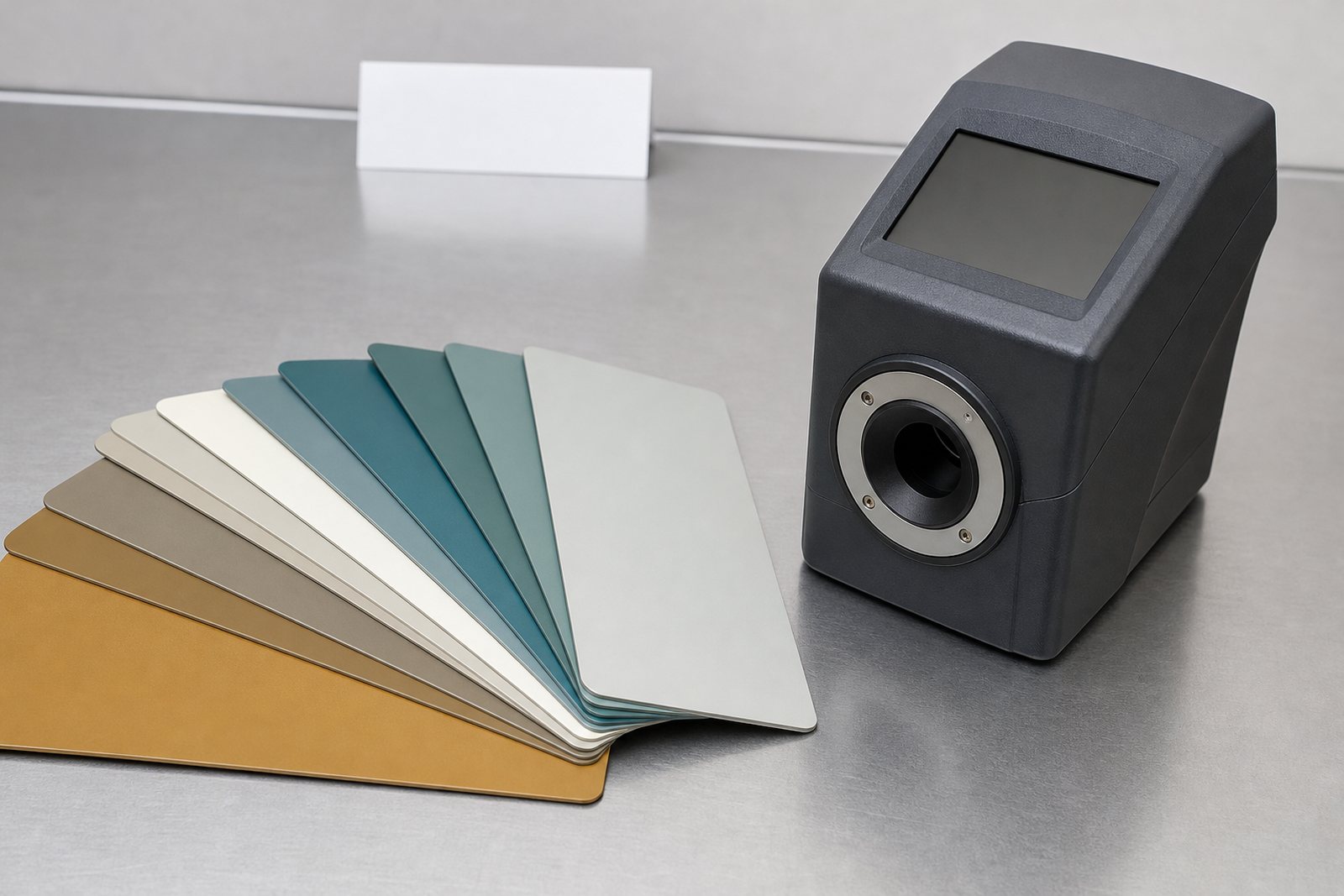
Colour matching
Matching a colour you already produce
Send a chip, a part or a Pantone code. You get a sprayed plaque, a measured ΔE and a decision between tinting the resin and painting the part — before anything is cast.
The workflow
Three steps between your chip and an approved batch
None of this is billable. It exists so the batch does not come back.
Send the target
A physical chip beats a code: Pantone numbers render differently on every screen. A part from your current production is better still — it carries the texture and gloss you will actually be compared against.
Read the plaque
We spray a plaque in the intended material and finish, measure it under D65 at 10° and send you the L*a*b* values and the ΔE against your target, with a photo under neutral light.
Approve, then run
You approve or we adjust. The approved plaque stays with the job and becomes the reference for every re-run, measured against it rather than against a number on a screen.
Tint or paint
Two routes, and they fail differently
This is the decision that most affects whether the second batch matches the first.
| Tint the resin | Paint the part | |
|---|---|---|
| Colour depth | Deep, translucent, "moulded-in" | Opaque and exact, incl. metallics |
| Change cost | High — the whole mix changes | Low — repaint at 20 pieces |
| Edge wear | Scratches stay the same colour | Shows a lighter line at impact points |
| Radius fidelity | Sharp as moulded | Film thickness softens tight edges |
| Best for | Clear, deep, soft-touch-free parts | Brand colours, metallics, 2K finishes |
Why a match drifts
Four reasons a colour fails after approval
Metamerism
Two samples read identical under D65 and different under the client's office lighting. Fix by approving under the light the part will live in, not just under the instrument.
Texture changes colour
A coarse grain scatters light and reads lighter than the same paint on a polished face. The plaque must carry the final texture, or the number is meaningless.
Gloss changes colour
Moving from matte to gloss shifts perceived depth by an entire step at the same ΔE. Lock gloss before you lock colour.
Pigment lot change
A new pigment lot can shift a batch. We re-measure the first shot of every re-run against the retained plaque, not against a stored number.
What you receive
The paperwork behind an approval
- L*a*b* values for target, plaque and production shot
- ΔE*ab figure with the formula stated (CIE76 or CIEDE2000)
- Photograph of plaque and part side by side under D65
- Notes on gloss unit and texture grade used for the reading
- Retained plaque kept for the life of the part programme
Standards we work to
Default pass criteria
ΔE ≤ 1.5 against the approved plaque as standard, ΔE ≤ 1.0 on flat faces when specified. Gloss held within ±5 GU at 60°. Tighter callouts on your drawing override these — we quote against your number, not ours.
Questions
Colour questions we get asked
What do you need from me to match a colour?
A physical chip, a part from your current production, or a Pantone code plus a photo of the surface. A physical sample is best because it carries the texture and gloss that the reading depends on — the same paint on a different texture reads as a different colour.
Will the cast part match my existing injection-moulded part?
It will match the colour, but not always the surface. Injection tooling usually leaves a different texture and gloss than a silicone mould, and both shift perceived colour. Send the moulded part as the target and we will match the whole appearance rather than the pigment alone.
How long does a colour approval take?
One to two working days for the first plaque, including the measurement and a photo under D65. If you need a second adjustment it is usually same-day, because only the paint mix changes — not the tool.
Do you charge for colour matching?
No. Plaques, measurement and one adjustment are included in the quotation. We only charge when the colour work itself becomes a development project, for example matching a multi-layer effect or a metallic that needs a specific flake orientation.
