Reference
Colour, gloss and texture: how we hit a target
The numbers behind a cosmetic approval — what we measure, with which instrument, and what counts as a pass. Bring your own criteria and we will quote against them.
The measurement sheet
What gets measured, and against what
Every cosmetic batch is released against this sheet. If your drawing carries a tighter callout, it replaces the default.
| Property | Instrument | Default pass criterion | Tighter option |
|---|---|---|---|
| Colour difference | Spectrophotometer, D65 / 10° | ΔE*ab ≤ 1.5 vs approved plaque | ΔE ≤ 1.0 on request |
| Gloss level | Gloss meter, 60° geometry | ± 5 GU of target | ± 3 GU on flat faces |
| Texture | Comparator plaque (SPI / VDI) | Visual match at 300 mm | Comparator match at 150 mm |
| Clear light transmission | Spectrophotometer, 2 mm section | ≥ 88% at 550 nm | ≥ 90%, haze ≤ 2% |
| Yellowing after ageing | 72 h QUV, Δb* | Δb ≤ 2.0 | Δb ≤ 1.0 with UV stabiliser |
| Parting line visibility | Visual under D65 at 400 mm | Not visible on A-surface | Polished blend, no witness line |
| Dimensional | CMM / caliper per drawing | ±0.15 mm / 100 mm | ±0.05 mm on small parts |
Colour
Tinted in the resin, or painted after?
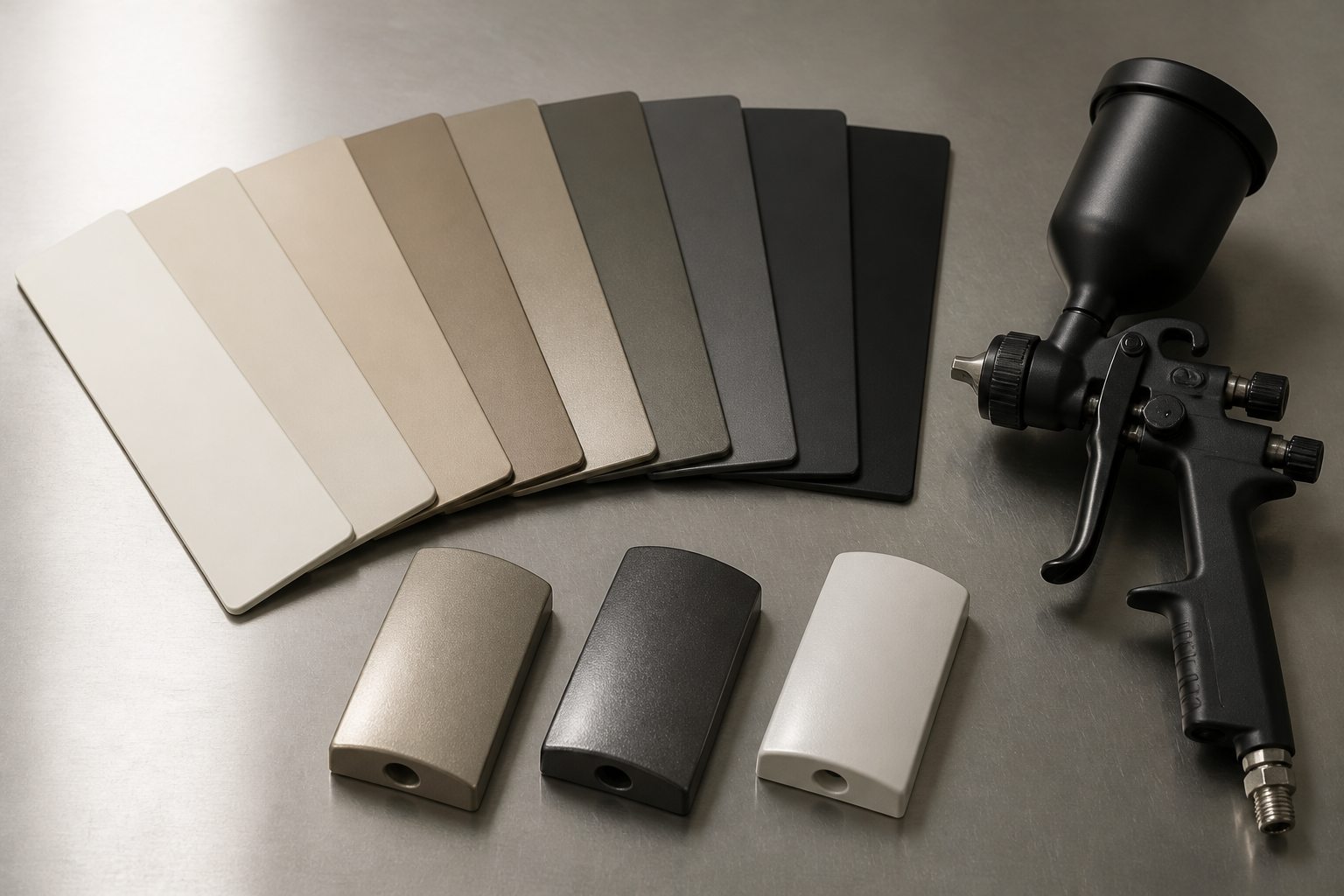
Both work, and they fail differently. Tinting the PU gives depth and hides scratches, but a tint shift is expensive to correct mid-batch. Painting gives an exact Pantone match and lets you change shade at 20 pieces, but it adds a film thickness that shows on tight radii.
- Resin tinting: best for deep colours, translucent parts and moulded-in look
- Painting: best for exact brand matches, metallics and 2K soft-touch
- We spray a plaque in the chosen route and measure it before the run
- Pantone, RAL and NCS references all accepted; a physical chip is better than a code
Gloss and texture
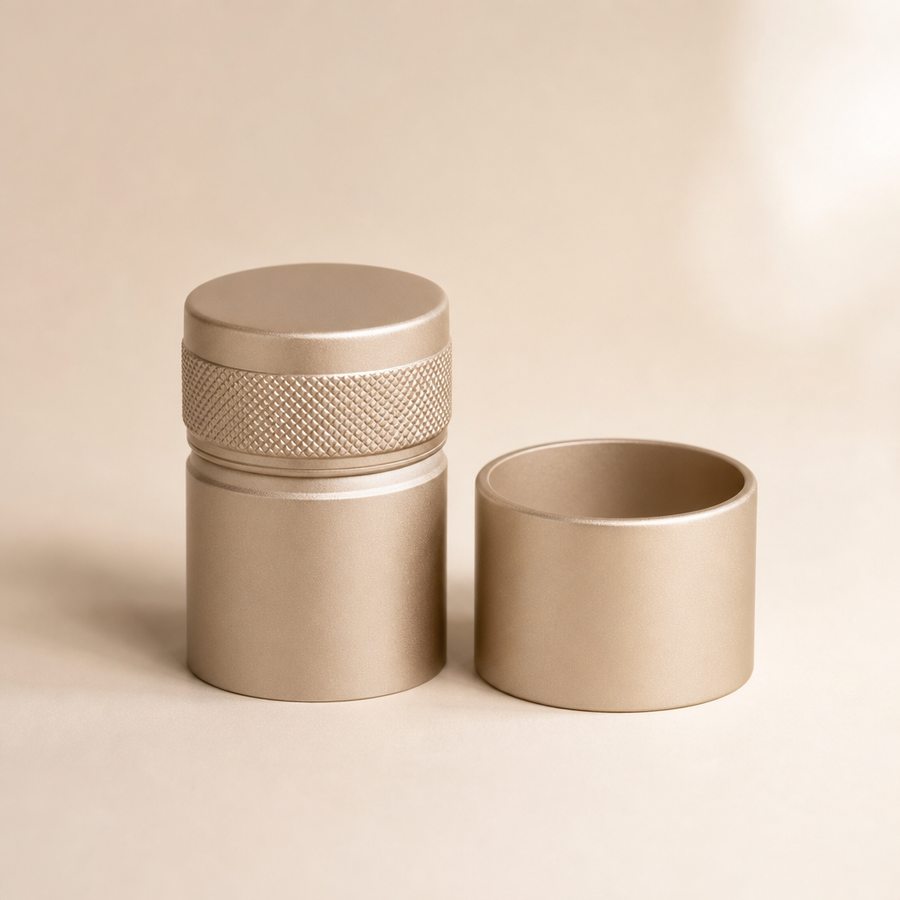
Three ways to get a surface, three different costs
Mould-cut texture
Etched into the master before the silicone is poured. Cheapest per part, repeats exactly across the batch, and dies with the mould at 15–25 shots.
Spray texture
Applied after casting. Lets you vary the grain per order without a new master, but adds a film that softens sharp edges and can chip on impact.
As-printed
MJF gives a fine even grain straight out of the build; SLS reads slightly rougher. Both are honest engineering finishes and cost nothing extra.
| Look | Gloss at 60° | Typical route | Wears how |
|---|---|---|---|
| Dead matte | 2–6 GU | Matting agent in 2K paint | Polishes to sheen where handled |
| Soft-touch | 3–8 GU | Elastomer coating | Skins over years; not for abrasion points |
| Satin | 20–30 GU | Mould-cut VDI 27–30 | Stable, hides fingerprints |
| Semi-gloss | 50–60 GU | Paint over polished master | Shows wear on high-touch faces |
| High gloss | 85+ GU | Polished master, clear coat | Micro-scratches accumulate visibly |
Clear parts
Water-clear is a separate discipline
Clear PU yellows, and it yellows unevenly — thick sections go first. For lenses and light pipes we specify a UV-stabilised grade, cast under vacuum to pull the bubbles, and measure transmission at the thinnest and thickest section of the same part.
If the part has to pass light rather than just look clear, send the photometric requirement with the drawing. It changes the resin choice, not the mould.
Questions
Asked before the first batch
Can you match a Pantone colour exactly?
We match the chip, not the code — screen renderings of a Pantone number differ between suppliers. We spray a plaque, measure it under D65 and send the ΔE reading for approval before the batch. Typical result is ΔE ≤ 1.5, and ΔE ≤ 1.0 on flat faces when you specify it.
Will batch two match batch one?
Yes, if we keep the approved plaque and the resin lot records, which we do for repeat parts. Between batches the risk is pigment dispersion in a new resin lot, so we re-measure the first shot of every re-run against the retained plaque rather than against a number.
Can you copy a texture I already mould in steel?
Send a sample or name the SPI or VDI grade. A mould-cut texture is etched into the master and then transferred by the silicone, so it repeats exactly for the life of the tool; a spray texture is applied after casting and is better when you want to vary the grain per order.
Why does a clear part turn yellow after a few months?
Standard clear PU oxidises under UV and the thickest section yellows first. We use a UV-stabilised grade for lenses and light pipes, cast under vacuum to remove bubbles, and quote a Δb limit after 72 hours of QUV so the ageing behaviour is a spec rather than a surprise.
Have a colour target and a drawing? Send both and we will quote against your own pass criteria.
Send a colour target