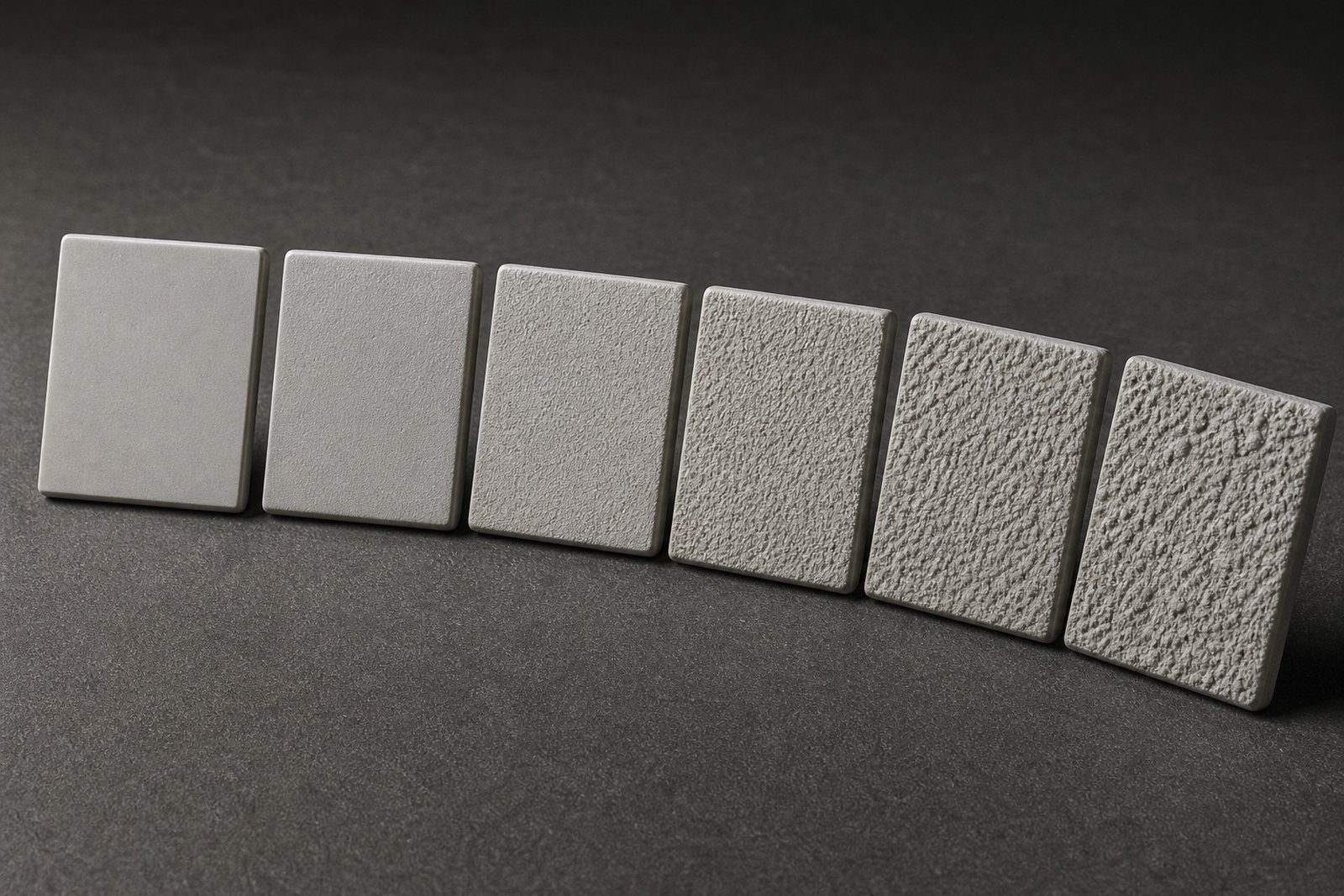
Texture reference
SPI and VDI grades: what the number looks like
A grade on a drawing only means something if both sides picture the same surface. Here is what each band looks like, what it costs, and how to specify one that survives a silicone tool.
The chart
SPI bands, read as surfaces rather than codes
Gloss figures are indicative ranges for moulded PU, not a specification. The appearance column is what a buyer actually approves.
| Grade | Typical prep | What it looks like | Gloss at 60° (indicative) | Common use |
|---|---|---|---|---|
| A-1 | 6000 grit diamond buff | Mirror; reflections read sharp | 90+ GU | Optical faces, high-end cosmetic caps |
| A-2 | 3000 grit | High gloss, slightly softened reflection | 80–90 GU | Appliance fascias, premium housings |
| A-3 | 1200 grit | Gloss with visible polish direction on flats | 70–85 GU | General cosmetic parts |
| B-1 | 600 grit stone | Semi-gloss; hides fingerprints | 50–65 GU | Consumer electronics shells |
| B-2 | 400 grit stone | Medium; a matte sheen rather than a reflection | 35–50 GU | Tool housings, interiors |
| B-3 | 320 grit stone | Matte with faint tool marks | 25–40 GU | Industrial covers |
| C-1 | 600 grit + texture paper | Fine uniform grain | 15–25 GU | Automotive interior trim |
| C-2 | 400 grit + texture paper | Visible grain, even under raking light | 10–20 GU | Handheld devices, tool grips |
| C-3 | 320 grit + texture paper | Pronounced grain; reads as a material choice | 8–15 GU | Enclosures, appliance panels |
| D-1 | Dry blast, glass bead 600 | Satin with a fine stipple | 10–18 GU | Medical housings, instrument cases |
| D-2 | Dry blast, glass bead 400 | Open stipple, clearly textured | 6–12 GU | Power tools, rugged enclosures |
| D-3 | Dry blast, glass bead 320 | Coarse, almost sandpaper-like | 3–8 GU | Grips, wear surfaces, hides handling |
VDI 3400 is a different scale, not a translation of SPI — a VDI number describes an etch depth pattern, so there is no one-to-one mapping. If your drawing cites VDI, send a comparator plaque photo or a physical sample instead of converting the number.
In silicone tooling
Two of these grades will disappoint you
A silicone mould transfers texture faithfully, but it also wears. The finer the grade, the faster the visible change across a run.
- A-1 and A-2 survive only a few shots before the polish dulls; plan them for 10–25 parts, not 200
- B and C bands hold their look for the full 15–25 shot life of a tool
- D bands are the most forgiving of tool wear — the texture hides drift
- Texture also hides sink marks and minor flow lines, which is why rugged housings are D-2 rather than A-3
Specifying
How to put a texture on a drawing
Name the band, not a number alone
"SPI C-2" is enough. A bare gloss figure without a texture callout will be read differently by every shop you send it to.
Say which faces
A-surface, B-surface and hidden faces usually carry different grades. A single note on a whole part pushes cost up without improving what anyone sees.
Attach a photo or sample
One photo of the surface you are matching removes more ambiguity than three lines of notes, especially when the reference is an existing part.
Decide mould-cut or spray
A mould-cut texture repeats exactly and dies with the tool. A sprayed texture lets you change grain per order but adds film thickness at edges.
Cost
What texture adds to a quote
Texture is one of the few cosmetic decisions that changes both price and lead time, because a master has to be finished before the mould exists.
- As-printed (MJF / SLS): no extra cost, no extra lead time
- B and C bands cut into the master: adds 1–2 days to first article
- A-1 and A-2 polish: adds 2–3 days and is charged per master
- Spray texture after casting: priced per part, not per tool
Related reading
Where this connects
The grade only decides half the look — gloss and colour interact with it. Our measurement sheet sets out the pass criteria for all three together.
Colour, gloss and texture tolerances
Questions
Texture questions, answered
Which SPI grade should I specify for a matte housing?
For a housing that should read as matte but still feel refined, SPI C-2 is the usual choice: it holds its look for the full life of a silicone tool and hides fingerprints and minor flow marks. D-2 goes coarser and is better for grips and rugged enclosures.
Can you reproduce a texture from my existing steel tool?
Yes, if we can see it. Send a moulded part, or a comparator plaque photograph taken under raking light. Etching a master is done in the same way whether the original was steel or silicone; what we cannot do is read a VDI number and convert it to an SPI band, because the two scales measure different things.
Does texture cost extra?
As-printed MJF and SLS surfaces cost nothing extra. A B or C band cut into the master adds one to two days to the first article. An A-1 or A-2 polish adds two to three days and is charged per master, because it is hand work on the tool rather than on the parts.
Why does my A-2 part look duller at part 30?
Because silicone tools wear. A high-polish master transfers its finish cleanly for the first shots, then the mould surface itself starts to dull, and every subsequent part inherits that. If you need a consistent gloss across 100 pieces, specify a B band or plan a second tool.
