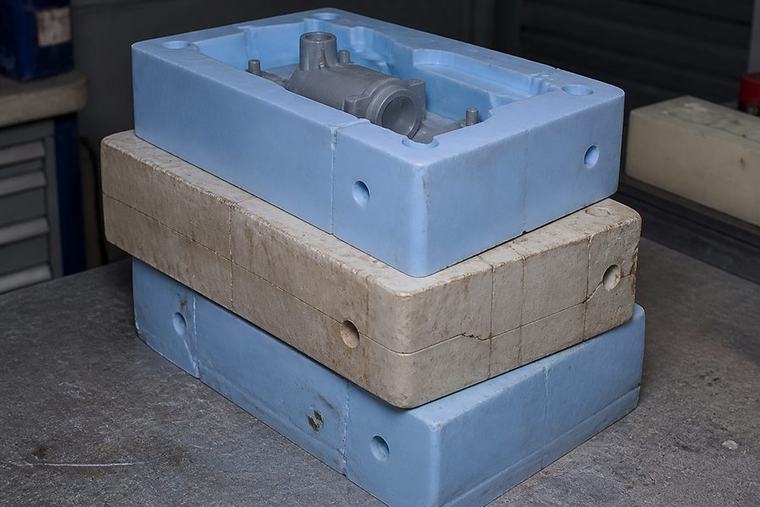
The tool is the product
People talk about a silicone mould as if it were a small injection tool. It is not. An injection tool is expected to survive a million shots and be repaired for a decade. A silicone block is expected to survive twenty-five, maybe thirty, and then be thrown away.
That is not a limitation to work around; it is the reason the process is cheap. You are renting a tool, not buying one.
What actually changes, shot by shot
Shrinkage drifts. Silicone compresses slightly with every cycle, so the cavity gets marginally smaller. On a 100 mm part this is invisible for the first ten shots and measurable by the twentieth.
The cut line opens. The block is cut to remove the master and closed again for each pour. Every closing stresses the same seam. By shot fifteen you can feel a step that was not there at shot three.
Texture dulls. A polished master transfers a polish. A worn mould transfers its own wear, and every part inherits it. This is why an A-2 finish looks right on part two and wrong on part thirty.
Three symptoms, three diagnoses
Parts getting progressively tighter on a bore means shrinkage drift. Plan a re-cut, or ream the bore after casting for the remainder of the run.
A visible witness line on what used to be a clean face means the cut line has opened. Sometimes a re-clamp and a fresh cure buys you five more shots; often it does not.
Gloss dropping across the batch means the mould surface is the problem, not the paint. Repainting will not fix a dull tool.
Plan the second block before you need it
If your order is 300 pieces, you are not buying one tool. You are buying three, whether or not anybody says so. The only question is whether the third block is poured on schedule or in a panic after part 210 ships out of tolerance.
Pouring a second block from the retained master is cheap and takes days. Discovering the problem at part 27 on a deadline costs the customer relationship, not the tool.
When to stop repairing
Repairing a worn silicone block is almost never worth it beyond a re-clamp. The material has compressed; you can close the seam but you cannot restore the volume.
The honest rule: if the first article off a repaired block is outside tolerance, stop. A new block from the retained master is between a few hundred dollars and a day of delay. A batch of 80 unusable parts is neither.
What a second block actually costs
A second silicone block poured from a retained master is roughly 20–30% of the first tool, because the master — the expensive part — already exists. It takes two to three days: pour, cure, cut, and cast a first article to confirm.
What it does not cover is a design change. If the master has to be reprinted and repolished, you are back to a first tool, not a second one. That is why retaining the master matters more than retaining the block.
Making a block last longer
Four things buy shots, in order of effect. Cool the block between pours rather than stacking hot parts. Release consistently — a thin, even film beats a heavy one that pools in corners. Store the block closed, with the cut faces aligned, so the seam does not set in an open position. And never leave resin sitting in the cavity.
None of these double the life. Together they reliably recover the last five shots of a block that would otherwise be retired at twenty — which is often exactly the five you need to finish a batch.
